Scheduling of IT service companies in business intelligence
Optimising scheduling management in a company specialised in Business Intelligence


In the demanding and evolving sector of Business Intelligence (BI), the ability to efficiently organise resources and missions is a key success factor. An IT consulting firm, an expert in the field of decision support, has the choice of using PlanningPME to optimise the management of its complex schedules. An IT consulting firm works on strategic projects for public and private organisations. Faced with growing demand and the diversity of services offered – including consulting, auditing, training and implementation of BI solutions – it must overcome a major challenge: effective structuring of its activities to gain agility and performance.
Complex needs and diverse projects
The business leads numerous projects involving teams of experts in several specialties:
- Technical advice and audits : migration of environments, security audits, implementation of AD/SSO authentication, etc.
- Specialised training : Web Intelligence, Talend, Crystal Reports, BI administration, Lumira and Power BI and/or others
- Development and production missions : Installation of BI solutions, ETL deployment, advanced reporting and platform migration.
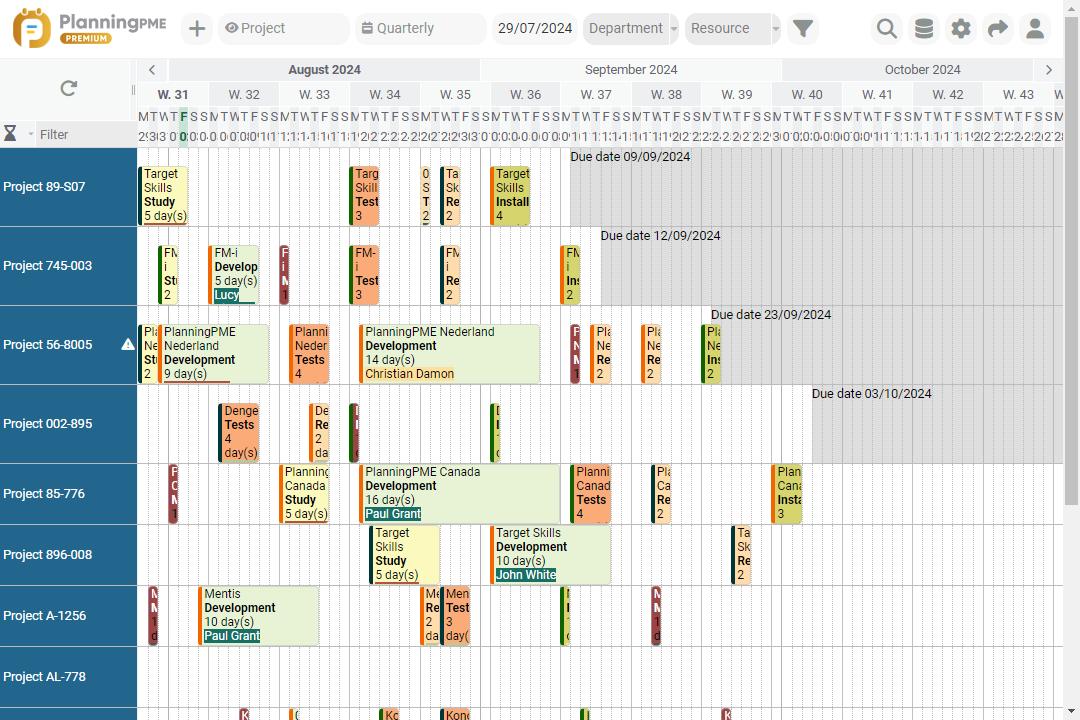
These services require rigorous coordination to meet deadlines, mobilise the right skills and ensure optimal customer satisfaction.
Try the project scheduling template
Challenges faced by an IT consulting firm
- A wide geographical distribution : Teams travel regularly to meet customer needs at different sites.
- Diversity of services : Each mission requires precise planning, whether it involves technical services, workshops, training or audits.
- Skills management : assign the right resources to projects according to their specific expertise (SAP BO, Talend, Power BI, ETL, etc.).
- Taking absences into account : holidays, sick leaves, internal training or university sessions, which complicate the organisation.
PlanningPME: the answer adapted to IT consulting firms
To meet these challenges, using PlanningPME makes it possible to simplify and automate the management of schedules for digital services companies.
- Centralised view of schedules : With PlanningPME, teams have a single dashboard that brings together all current missions, training and projects. This centralisation allows them to monitor activities in real time and anticipate potential scheduling conflicts.
- Structure tasks by categories : Each task is categorised for better clarity: internal and external trainings (WebI, Talend, Power BI, Lumira, etc.), technical missions (audit, installation, securing BI environments) and internal projects (technical workshops, management, platform migrations).
- Assignment by skills : The tool enables assignments to be allocated on the basis of the resources' specific skills: SAP BusinessObjects expertise (Web Intelligence, UDT, IDT, Dashboards), ETL skills such as Talend, Data Services and SSIS, advanced skills in Power BI, HANA data analysis and/or any other skills. Each consultant is assigned to projects that match his or her expertise, guaranteeing optimum quality of service.
- Easy leave and absence management : PlanningPME takes into account all periods of unavailability (holidays, sick leaves, training) to avoid project interruptions. Managers benefit from a clear view of available resources and can adjust schedules accordingly.
Benefits obtained
Using PlanningPME allows IT consulting companies to:
- Improve organisational efficiency : Schedules are optimised to avoid conflicts and maximise productivity.
- Gain visibility : An overview of projects and resources facilitates rapid decision-making.
- Optimise skills : Each mission is entrusted to the most suitable experts.
- Simplify leave and absence management : periods of unavailability are anticipated, ensuring project continuity.
Finally, more fluid organisation and better control of deadlines improve customer satisfaction.
Transform your organisation with PlanningPME
By choosing PlanningPME, companies specialising in Business Intelligence are transforming the way they manage their schedules to achieve greater efficiency, visibility and flexibility. Whether it's organising training courses, planning audits, coordinating complex migrations or any other tasks the tool has made it possible to meet the challenges of a dynamic and demanding sector. Find out how PlanningPME can help you organise your projects and optimise your resources to achieve your goals.
Customers case studies - Testimonials
Testimonials

Discover the success story of our client Interdata
Interdata plans services for its clients with PlanningPME
Company Overview
Positioned in the areas of optical networks, architecture and network security, Interdata is recognised as a high added value integrator. Its offer is aimed at operators, businesses of all sizes and large administrations.
For more than 30 years, the company has gained a solid reputation. Avant-garde, she researches innovative products, imports them and introduces them to the French market. His new areas of focus are mobility, BYOD projects, compliance and access control. Interdata intervenes from the simple configuration to the installation of a complex network: study, design, integration, training, support and maintenance, supervision, administration (NOC), managed services. Interdata and its subsidiary J3tel (specialist in Metrology of Information Systems) are based in the Paris region. The group has a turnover of € 30 million and employs 100 people. The company has been ISO 9001 certified since May 31, 2002.
Our scheduling needs
- Have a real business solution for planning management, centralised and editable / searchable in real time
- Need for more visibility on the availability of technical teams in charge of interventions (internal and / or external), facilitate the planning of resources, all with a global vision over several weeks or months
- To manage our human and material resources (rooms, vehicles, test equipment ...), grouped into separate services, with customisable permissions and visibilities according to the teams
Manage technical teams and customer projects
PlanningPME is used daily by our entire technical department to manage service plans as part of our client projects (installations, interventions, training, presentation of our solutions ...).
This management integrates the unavailability or leave of the technical teams, as well as the employment contracts for the staff in apprenticeship or fixed-term contracts.
At the company level, we manage all material resources (meeting rooms, intervention vehicles, test or demonstration equipment, etc.).
To date, more than 40 users are using PlanningPME on a daily basis to manage their calendar, which synchronises with their Outlook client.
In addition, the human and material resources schedule can be consulted by all the staff of the company, via a simple browser, using the PlanningPME HMTL application.
FAQ
By centralising information in a single tool, PlanningPME provides an overview of projects, tasks and resources. No matter where teams are located, managers can track ongoing missions, planned training and absences in real time, while adjusting priorities as needed.
Each resource has personalised profiles in PlanningPME, with detailed information on their skills: SAP BusinessObjects, Talend, Power BI, HANA, BI administration, etc. When scheduling, managers can thus select the best experts for each task, aligning skills to specific projects.
The tool allows you to integrate all periods of unavailability (holidays, training, sick leaves) into schedules. Automatic alerts avoid organisational conflicts by anticipating absences, which ensures the continuity of missions and the appropriate distribution of remaining resources.
The main benefits are: Optimisation of schedules with better resource management, considerable time savings by automating organisational processes, increased customer satisfaction by meeting deadlines and assigning experts suited to projects, and operational flexibility allowing rapid adaptation to priorities and unforeseen events.